Showing posts with label Innovation. Show all posts

Sunday, August 22, 2010

The End of Management

PT-AP668_manage_G_20100820153607[1] You have to read this very nice article about management and how it doesn’t fit into the 21st century:

http://online.wsj.com/article/SB10001424052748704476104575439723695579664.html

Very good research collection on how the model of large managed corporations will be obsolete in the future and Enterprise 2.0 will get successful.

We can see many examples in the corporate landscape that follow the path of Enterprise 2.0 like

  • SAS (listed in the article)
  • Dell and Starbucks (collecting ideas from outside the company)
  • Nike (design your own products)
  • Zappos (flat management structure and motivated employees)

I am sure the list goes on and on (feel free to add examples in the comments section) and shows that there is a need for change in our thinking in regards to management and the way we (want to) work. That is why I wrote about the “Customer Relationship Model 2.0” and not referring to it as “Management” anymore…

What do you think about this? Another hype that will be forgotten in 5 years? Traditional Management is about to die? Or something in the middle?

Friday, July 4, 2008

Apple's customer experience


I just read an article about Apple that was confusing me because they for sure create a fantastic product experience, but they are probably the most un-collaborative (does this word exist?!) company in this arena. Apple is actually doing everything possible to not communicate with its customers. Their policy is to keep everything product related as secret as possible. Even different departments within the company do not know what the others are doing. That avoids that somebody gets the full picture of a new product and accompanied with strict prohibitions in the employees contracts about what they are allowed to talk and to whom, it allows Apple to gain a competitive advantage that is massive (expected three years for the iPhone). When products leave the labs at apple, they are extremely stable and have only few bugs (although they are found quickly and the example of the iPod battery shows that consumers are able to strike back...).
The buzz that is created by new apple products allows Steve Jobs to leave customers in the dark during the development process without harvesting the negative feedback that everybody would expect. While Google motto is "Don't be evil", it looks like Apple's is the opposite. The leadership methods of Apple are antipodal to the open and collaborative ones that are common in most of the Hi-Tec and Software companies these days.
Interesting enough - Apple is tremendously successful with this strategy, gaining more and more market space from companies like Microsoft that recently started to open up to it's customers. Is this just an exception or will this market - which seems to be a precursor for CRM 2.0 strategies - fall back into traditional ways of leadership and marketing?

Technorati Tags: , , ,
Undergoing MyBlogLog Verification

Sunday, June 29, 2008

The Customer Experience

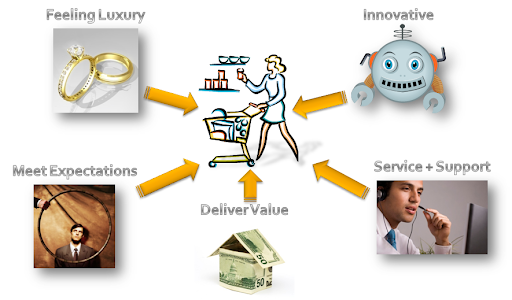
Some CRM vendors talk about Service and Support when they push the Customer Experience. But the full Experience of a product or brand is so much more than that (although service is a crucial part of it...)!

What is the Customer Experience and why is it so important?

Creating an Experience means that the consumer receives a product or service that emotionally touches her/him and leaves an impression that is positive in all areas.


The Web 2.0 technologies allow empowered customers to share their experience with thousands of other users or potential users. If the experience is negative it will seriously harm a brand - if it is positive the customer becomes an advocate and kicks of the viral marketing machine (don't like that term).

A CRM 2.0 strategy must acknowledge the power of customers and actively create an Experience that is unique and all positive. This could be achieved by engaging the customer in a real dialogue and listen carefully to what e says. Innovation has to be a central part in such a strategy as well. Innovation from both sides, internally and externally.

The consumer will only become an advocate for a brand or product if if it delivers a great value (which is not related to the price!). In general the consumer is looking for products and services that leave them with a good feeling which might be created by innovation, the price, the uniqueness or the reputation.

Technorati Tags: ,

Thursday, June 26, 2008

Innovation centric

A. G. Lafley suggests in his book "The Game Changer" that companies should be centered on innovation. But he admits himself, that innovation that does not bring value to customers is nonsense...

So shouldn't the business be customer centric then?

I think there are many ways for customers to influence innovation and the products that come out of it. This graphic should visualize on a high level how that could look like:


The Web 2.0 will increase the influence of customers on innovation massively. Companies that actively support this development will profit from it and gain competitive advantage while companies ignoring it and staying with the old fashioned 'isolated' innovation process might not be able to create a customer experience that makes customers loyal.

Technorati Tags: , ,