Showing posts with label Strategy. Show all posts

Saturday, December 1, 2012

CRM is not about “managing” customers (anymore…)

CRM 2.0 is the move away from the transaction based “management” of customers (one way pushing marketing information) towards a real two way dialogue that is based on trust on both sides. To discover the full benefits of a changing customer behavior that is arising with new technologies, it is necessary for companies to open up, share information and start listening to customers instead of just pushing marketing messages out into the market. Engaging in such a meaningful conversation will help to discover new ideas and align products and services with the customer demand. It further leverages the willingness of users to contribute to the development and enhancement of products, services or ideas.

It has to be kept in mind that CRM 2.0 is not just a technology or software tool but consists of several components that all need to be considered and eventually implemented.

image

The underlying technology is only a minor matter but has to support the shown elements. Open Source software and Software as a Service (SaaS) can help to reduce the cost for the IT infrastructure in order to set the clear focus on the strategically more important parts like the required change in corporate culture.

Technorati Tags: ,

Friday, May 1, 2009

Sometimes you have to ignore your customers!

Jensen Huang (Co-Founder of NVIDIA) has an interesting sight on Corporate Vision and the fact that you have to ignore the customer base in certain situations. That is when you are sure that your vision is so much stronger than that of your customers:

This is actually a good point and sometimes probably necessary to differentiate from competition. Risky, though, when you completely lose contact to the end-users.
For NVIDIA it worked out quite well. But as Jensen said, they were competing against 200 other graphics chips producers in the 90s, so differentiation is sometimes hard and might really lead to the ignorance of customers (for a while).

A CRM 2.0 strategy must not always mean that a business has to blindly follow what customers demand. Some products or services might not have an obvious business case (i.e. will not create immediate money), some might see no demand at the time you have to start developing them. Still they can deliver in the mid- or long-term if there is a strong vision behind it (and the vision fulfills).

A Revolution needs strong leadership and only a limited number of people are able to discover this in an early stage.

Apple is another good example where products are created with very little or no involvement of (potential) users. A very successful example as we all know… The question is do I really want to completely ignore customers? And if so, for how long?

I think executing on a strong vision does not mean that you have to lose contact with your customers. There are always some people out there that share the same vision. It’s all about finding these individuals and getting them into the boat. The connected (Web 2.0) world these times is a tremendous help here!

So CRM 2.0 is also about finding the right people out there and co-creating products and services with them. If done well, these customers will get real advocates for the brand.

Technorati Tags: ,

Friday, January 30, 2009

Enterprise 2.0

Space_shuttle_enterprise Andrew McAfee defines Enterprise 2.0 as “the use of emergent social software platforms within companies, or between companies and their partners or customers”.

According to his definition, CRM 2.0 is part of Enterprise 2.0 because he extends the use of social software to partners and customers – interesting thought. For me though, Enterprise 2.0 is a (crucial) part of a CRM 2.0 strategy, but not the other way around.

To successfully implement a CRM 2.0 strategy, it is necessary to change the corporate culture towards collaboration, co-creation and transparency - Using the Web 2.0 tools within the corporate is a logical and required step.

Good thing is that Generation Y will ‘naturally' bring some of this culture into the enterprise, as they grew up with the Web 2.0 and do not have the reservation that Gen X and the Baby Boomers have. Of course social software within an enterprise has higher requirements towards reliability and security, which might disqualify some of the services that are already out there and are widely used. Salesforce.com seamlessly integrating Google Docs is a brilliant example of how enterprise 2.0 (within a CRM 2.0 strategy) could look like. Microsoft Office Live might follow up, soon.

I am pretty sure we will see more and more companies using channels like Blogs, Twitter or Instant Messaging. Not only externally but also internally. Missing standards make interoperability between the different media and among the different platforms difficult, though.

Saturday, January 24, 2009

The dark side of Web 2.0

800px-Web_2.0_is_here

Besides the obvious positive effects of the world wide web becoming social, there are some effects that we might forget or underestimate, yet.

Agreed, it is a good thing that everybody can freely express their thoughts and views (and now being heard through the Web 2.0…), but what about things like professionalism, proper research and  knowledge of the topic?

The Web 2.0 - and the resulting transparency - in many areas could result in unqualified and simply untrue expression of opinions that result in witch hunts or have serious negative impact on the targeted persons, products, brands or companies. While in old fashioned journalism the contributors are professionals that do proper research before publishing a story – in the Web 2.0 world a lot of the commentators have no glue of what they are talking about and do not have the knowledge or time to deal with the topic in the required detail.

Of course given that the amount of information and the number of contributors on the internet is very large, it will be difficult for a single person to make an impact being heard my many others. But when minorities get organized, they could well make a much bigger impact than the not so organized majority.

Is this our digital way to global Anarchy ??

Well, as always, nothing is eaten as hot as it is cooked…
Yes - it will be possible to harm somebody by publishing negative or even untrue statements on the internet and it might be possible to initiate a Tsunami with many people following and propagating the negative statement, but in the end there is still our common sense. And as easy as it is creating negative mood, as easy it is to create positive feedback for someone or something.
And as easy as it is to discredit someone, as easy it is for them to defend themselves using the same tools and techniques as the initiator.

As long as companies understand the Web 2.0 and its possibilities, they can utilize it to create a positive PR - connecting to their customers so that they become advocates and protect a brand, product or service from harm resulting of activities initiated by well organized minorities.
A well thought CRM 2.0 strategy helps organizing customer relations in this new world and ensures success in the future of our changing global business.

Technorati Tags: ,,,

Monday, January 19, 2009

I hate SIEBEL ?!

An interesting development going on that relates in two ways to the CRM 2.0 topic – Firstly it is about a CRM Software Vendor and secondly it happens in the Web 2.0

ihatesiebel

Recently I noticed a new group on Facebook called “I hate SIEBEL” which turns out to be a gathering of people that are frustrated with the Siebel CRM Platform. My understanding is that the group was created as a platform to shout out the frustration at Telstra when they moved to the new CRM Front-(and Back-)End but has now evolved to a group of 1,556 (Jan 19th, 4:40pm) members posting 320 comments on the wall and seriously affecting the brand image of Siebel Systems and Oracle.

As I was involved in the efforts at Telstra to re-vamp their complete IT, I have a rough understanding how things work there – or supposed to work I must say. And although I was competing against Siebel and Oracle in my previous job at Amdocs and do not know what exactly is causing the trouble at Telstra, I doubt that Siebel and the CRM Frontend is the only root-cause for this.

Interesting enough how thing have evolved, though. Siebel gets hammered (being the visible part to the agents) for all the issues with Telstras NextGen BSS/OSS System. This seems to be a very good example of the dynamics in the Web 2.0 and the possible harm that users can do to a brand. It shows the importance of a CRM 2.0 strategy and the (currently) missing awareness in some companies.

Friday, December 26, 2008

CRM 2.0 tipping point?

questionmark What will be the tipping point for CRM 2.0? What (and when) will be the single event to make it mandatory for every company to succeed?

Will it reach the critical mass at all!? Is this just another hype and one more buzzword that will be forgotten in two years?

There are examples like Apple that show it is possible to operate a successful company without actively including customers in the process of creating and evolving products and services (although they do a very good job in listening to their customers...)

Maybe there will be two kinds of CRM strategies in the future - one that gets into a true two-way discussion with the customer and builds on co-creation and co-operation; and another one that keeps focus on operational efficiency or competitive advantage through unique (kept secret as long as possible) features and functions?

I believe it is possible to create an outstanding customer experience without any CRM 2.0 strategy. It might depend on the product or the corporate culture if it makes sense to deeply involve customers in the processes or not.

Taly Weiss collected some predictions form 'Social Media influencers' on what they think will change in 2009:

A Merry Christmas to all of you out there...

Sunday, December 21, 2008

Business Velocity

Ciaran Dynes (Director of Product Management at Progress Software) presented some numbers that made it very visual how fast our world is currently changing... and it will get faster and faster in the future...

Business Velocity
View SlideShare presentation or Upload your own. (tags: business velocity)

With this ever increasing business velocity, the need for a new Customer Relationship Model is also increasing. The traditional CRM systems and strategies are not able to keep up with this acceleration.

Technorati-Tags: ,

Wednesday, December 17, 2008

Company Model of the future?

Zappos is not very much known over here in Europe, but the consistent empowerment of the own employees could be the future model for a successful CRM and corporate culture. Happy employees serve happy (and loyal) customers...

Technorati Tags: ,

Thursday, December 4, 2008

CRM 2.0 is not an IT challenge...

38852_i0_-_lost_bits_4 Our CTO, Hub Vandervoort, talks about the challenges to implement an SOA and concludes that this is also not only a matter of the right Software or Tool-Set, but a challenge to get people collaborating and communicating with each other (see SOA- Socially Oriented Architecture).

The same applies to CRM 2.0! Software will only support a new Customer Relationship Model - the more important part is the strategy and the shift in peoples heads that has to happen.

While technology was the initiator (Web 2.0) to create the demand for CRM 2.0, it will not be the solution to deal with it.

Friday, November 7, 2008

Oracle seems to get it

22008741_61203401 Anthony Lye from Oracle has a good vision of what CRM 2.0 really is about. And although CRM 2.0 is still not a tool or an installer that you can put on a server and be happy - It is important to have the right tools to engage users and be able to connect people and systems in an efficient way.

Anthony realizes the need to break through the very limited process-focused view of traditional CRM and connect to customers in a new and collaborative way. This is not only about gathering data from social networks and generating leads - its also about contributing to these networks and create value for the customers.

I specially like the fact that Oracle utilizes the OpenSocial API introduced by Google. It is always good if tools are based on standards and open source code. In this case it allows developers from the social networks or other Web 2,0 applications to provide interfaces to their platforms.

Monday, November 3, 2008

CRM 2.0 only for complex sales?

1071220_supermarket_pushcart_02 Anthony Lye from Oracle suggests that Web 2.0 features are more useful for complex sales situations rather than the High-Volume, Low-Margin business (like Amazons retail business).

But is this really the case? What about features like customer ratings and reviews for example?
These are Web 2.0 features that are more useful the more people use it (requires to pass the critical mass!).

Of course it is not possible - from a companies perspective - to stay in close contact to millions of customers worldwide in a very personal way. But doesn't that even more cry for a Customer Relationship Model that engages the customers to share their opinion and get into contact with other buyers and users?

I believe that CRM 2.0 could (and will) be used in both scenarios and deliver equal benefits on both sides of the sales spectrum. Of course the features being used will be different, but still they require to change the mind-set of employees and management... and of course a properly developed CRM 2.0 strategy...

Technorati Tags: ,,

Wednesday, October 22, 2008

Analogy to the TV revolution

Brian Halligan raised a good point - isn't the current (r)evolution of Customer Relationship Management (or Customer Relationship Model) very similar to the dramatic changes in Marketing with the introduction of the television 50 years ago?

The TV completely changed the way of marketing and 1089124_tvadvertising! Some companies were able to leverage the new tool and grow dramatically (Coca Cola, P&G, etc.) while others got stuck with their traditional way of marketing and did not grow or even went out of business.

Very similar to what the Web 2.0 does with CRM! Customers discovered how to avoid the traditional advertising - i.e. one way or push communication - overload and more and more using new ways to do their purchase decision. The social networking is playing an important role in this decision.

With a good CRM 2.0 strategy, companies can leverage this development and grow with it. Staying in the old fashioned structures might not be a good idea...

Monday, October 20, 2008

Social CRM is not a product you can buy!

When I am reading through Oracle's Vision of Social CRM (http://www.oracle.com/applications/socialcrm/index.html) I keep thinking that this is really missing the "social" component at all.

What defines a CRM to be "social" ?
How can a product help you achieve this ?
What is the outcome of social CRM ?

Adding some Web 2.0 collaboration tools doesn't help without a properly defined and executed (yes, I came to the conclusion that excution is AS important than strategy :) CRM 2.0 strategy.

It is all about how we leverage the existing tools to create a unique customer experience that differentiates a company from competition. There is no CRM 2.0 installer! There is no way around activating the brain and spending some thoughts of how that really works...

Wednesday, October 15, 2008

93 percent of Americans want companies to have a presence in social media...

New research from Cone LLC finds 93 percent of Americans want companies to have a presence in social media. (more)

This is an impressive number and shows the importance for a CRM 2.0 strategy. Although the study says that the demand is high, the people asked were unsure about the ways this can be achieved.

  • 43 percent say companies should use social networks to solve customer service issues;
  • 41 percent want businesses to ask for customer feedback on products and services; and
  • 37 percent believe organizations should develop new ways for customers to interact with a brand via applications and widgets.

As the "how" is not clearly defined, yet, there is a good opportunity for early adopters to utilize new Web 2.0 techniques and platforms to engage customers and get into a fruitful conversation with users and potential buyers. Being the first always helps to reach the critical mass that is so important in social networks and the Web 2.0 universe!

Technorati Tags: ,

Saturday, August 23, 2008

Viral Marketing and CRM 2.0

Viral Marketing (did I mention that I don't really like that term?) can be a powerful marketing tool, especially if the budget is somewhat limited...

...but...

this shot can easily backfire!

Candians PCWorld has put together a list with 'viral' marketing campaigns that really did not deliver the expected result.


What about risks in CRM 2.0 using social networks?

Similar to Viral Marketing, CRM 2.0 utilizes social networks to gather information about the customer and establish a ralation - ideally making customers loyal to the brand or product.
What happens if the engagement in social networks fail or even show negative results (i.e. consumers run away or make fun of the products)?

A very important part of a CRM 2.0 strategy must be a management of the engagement in social networks that allows to intervene if thing start running out of the rudder. As high as the gains of CRM 2.0 can be, as high are the risks.
This shows the importance of a well defined CRM 2.0 strategy that does not blindly engage customers and use the nice&new Web 2.0 world, but create a concept that will bring real value to consumers and make them loyal to brand or products.

Technorati Tags: , , ,

Thursday, July 31, 2008

CRM 2.0 - Vendor selection process

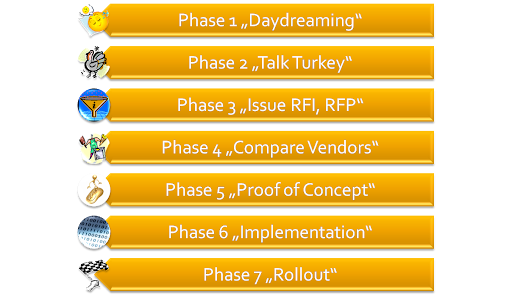
Here are my thoughts about vendor selection process and implementation phases - any comments highly appreciated!


Phase 1 „Daydreaming“
  • Determine Business Needs
  • What are the challenges?
  • What was the initial reason to think about a new CRM strategy?
  • Get help from an external advisor if necessary.
  • Define the ideal CRM solution
  • Outline the Hi-Level requirements
  • See the company from a customers‘ perspective

Phase 2 „Talk Turkey“
  • Come back to reality – you can not archieve everything you wish (what about ROI?)
  • Sync with existing CRM strategy and business processes – approve a project
  • Priotize the wishlist – separate the crtitical points from the nice-to-haves
  • Discuss with customers, employees and advisors
  • Identify the technology to be used (i.e. SaaS)

Phase 3 „Issue RFI, RFP“
  • Create a list of required functionality
  • Send this list to anumber of vendors (4-8)
  • Find a rating scheme and qualify the returned answeres
  • Ask the vendors to create a proposed solution
  • Asses and compare the outlined solutions
  • Find the two (or three) best fitting vendors
  • Focus on the vendor rather than the product
  • Technology must fit the strategy!

Phase 4 „Compare Vendors“
  • Does the corparate culture fit?
  • Is the vendor financial stable and is the roadmap promising and complete?
  • Is the product future proof (technology, platform), can it grow with your company?
  • Pricing model and license cost
  • Cost of implementation and customization
  • Required Hardware

Phase 5 „Proof of Concept“
  • Find a business process that covers as much technical aspects as possibe but can be implemented within a three week timeframe
  • Ask vendors to implement this business process with their product on site
  • Have IT and business people supervise the customization and administration process – get their buy-in!
  • Finish with a workshop where the vendor presents the PoC and answers questions how it was done
  • Try to estimate the efforts for the full project

Phase 6 „Implementation“
  • Keep business involved - gather feedback from future users during the implementation phase
  • Create reusable application code
  • Keep future upgrades in mind
  • Involve customers as beta-testers
  • Favor a staged approach for a ‚big bang‘

Phase 7 „Rollout“
  • Let users decide, not the contract – usability is the most critical factor...
  • Design DOES matter!
  • Provide detailed information to users (employees and customers)
  • Training
  • Collect feedback and keep improving the functionality and business processes
Technorati Tags: , ,

Wednesday, July 9, 2008

Asking the right questions...

Carly Fiorina, ex HP CEO, says that good leadership requires asking the right questions:

I totally agree with that! And further it is important whom you are asking these questions... and like she says, the customer always knows that something is wrong. And even if a customer cannot exactly tell what - listening to customers is crucial to detect the need for adjustments and change. A good leader will know what to do from her/his experience even if it is not articulated correctly.

Having an outstanding leader saying this, emphasizes the need of a customer centered Corporate Strategy. This might be the essence of CRM 2.0...?

See also Christo Norden Powers book on Powerful Questions to learn how to ask the right questions - although this is more focused on a one to one environment. For a company, analytical CRM will deliver the answer (when having asked the right questions to the software :).

Technorati Tags: , ,

Friday, July 4, 2008

Apple's customer experience


I just read an article about Apple that was confusing me because they for sure create a fantastic product experience, but they are probably the most un-collaborative (does this word exist?!) company in this arena. Apple is actually doing everything possible to not communicate with its customers. Their policy is to keep everything product related as secret as possible. Even different departments within the company do not know what the others are doing. That avoids that somebody gets the full picture of a new product and accompanied with strict prohibitions in the employees contracts about what they are allowed to talk and to whom, it allows Apple to gain a competitive advantage that is massive (expected three years for the iPhone). When products leave the labs at apple, they are extremely stable and have only few bugs (although they are found quickly and the example of the iPod battery shows that consumers are able to strike back...).
The buzz that is created by new apple products allows Steve Jobs to leave customers in the dark during the development process without harvesting the negative feedback that everybody would expect. While Google motto is "Don't be evil", it looks like Apple's is the opposite. The leadership methods of Apple are antipodal to the open and collaborative ones that are common in most of the Hi-Tec and Software companies these days.
Interesting enough - Apple is tremendously successful with this strategy, gaining more and more market space from companies like Microsoft that recently started to open up to it's customers. Is this just an exception or will this market - which seems to be a precursor for CRM 2.0 strategies - fall back into traditional ways of leadership and marketing?

Technorati Tags: , , ,
Undergoing MyBlogLog Verification

Wednesday, July 2, 2008

CRM market still growing fast

AMR says the market for CRM software will grow with double digit rates.
This is pretty interesting given the fact that so many CRM projects still fail... Do companies realize that buying a CRM software is not sufficient to be successful?

What about the required changes to company strategy and employee behavior? According to AMR the Web 2.0 technology is mostly demanded in the SFA arena - but what about service and support? What about marketing and innovation?

Let's hope the software vendors get the basics right so that users of their platforms will finally be able to focus on the required strategic and behavioral changes towards CRM 2.0...

Technorati Tags: , ,

Monday, June 30, 2008

The Customer changes... so do companies?

I know this youtube video is pretty old, but it still perfectly visualizes what happens if companies do not change and adopt the new Web 2.0 world...


But is a CRM 2.0 strategy everything it requires to make customers happy? What else does it take to make consumers loyal to a brand or product - why and when do they become advocates?

Technorati Tags: , , ,