Showing posts with label concepts. Show all posts

Saturday, October 3, 2009

Socialnomics: Social Media Revolution

Looks like there is a new name in town… what happened to the Wikinomics?! The short version of the video mentioned earlier also re-uses the business velocity theme.

Check out the interesting video response from tippingpoint labs:

Not 100% sure if the hula hoop is a valid comparison, though… what is the value add of a hula hoop, really? not much I would guess. Social Media has more to offer I’d say.

Friday, December 26, 2008

CRM 2.0 tipping point?

questionmark What will be the tipping point for CRM 2.0? What (and when) will be the single event to make it mandatory for every company to succeed?

Will it reach the critical mass at all!? Is this just another hype and one more buzzword that will be forgotten in two years?

There are examples like Apple that show it is possible to operate a successful company without actively including customers in the process of creating and evolving products and services (although they do a very good job in listening to their customers...)

Maybe there will be two kinds of CRM strategies in the future - one that gets into a true two-way discussion with the customer and builds on co-creation and co-operation; and another one that keeps focus on operational efficiency or competitive advantage through unique (kept secret as long as possible) features and functions?

I believe it is possible to create an outstanding customer experience without any CRM 2.0 strategy. It might depend on the product or the corporate culture if it makes sense to deeply involve customers in the processes or not.

Taly Weiss collected some predictions form 'Social Media influencers' on what they think will change in 2009:

A Merry Christmas to all of you out there...

Monday, October 13, 2008

Semantic Web

Technorati Tags: ,

What is the value of being able to search 124 billion web sites on cuil if I just want to have an answer to a simple question?

The Semantic Web will be the future answer to bring meaning into the fast growing information overload that the Internet delivers. It will be able to answer questions and - combined with mash-ups - show exactly the information we need rather than five thousand search results which I will never ever be able to look at.

In the context of CRM 2.0, the Semantic web will help internally to understand customers better and externally help deliver a unique experience that differentiates from competition.

..more to come...

Sunday, August 24, 2008

CRM 1.0 vs. CRM 2.0

  • Starts with a (ready developed) product
  • Strong Focus on SFA
  • Gathers information about the customer
  • Where is the Customer Relation?
  • Where is the value (+experience) for customers?
  • Process focused (Inside-Out view)
  • Provide content to engage consumers in a conversation
  • Collaborate on products and services
  • Listen to users and customers
  • The consumer engagement will lead to loyal customers
  • This will create a Meaningful Customer Relationship that brings value to both sides!
Technorati Tags: , , ,

Thursday, July 31, 2008

CRM 2.0 - Vendor selection process

Here are my thoughts about vendor selection process and implementation phases - any comments highly appreciated!


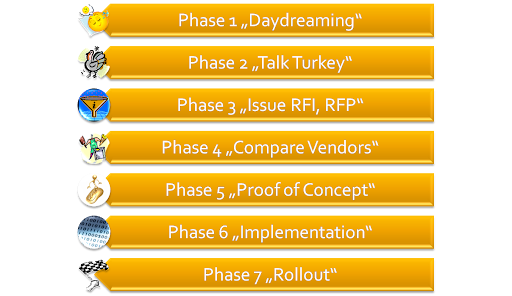
Phase 1 „Daydreaming“
  • Determine Business Needs
  • What are the challenges?
  • What was the initial reason to think about a new CRM strategy?
  • Get help from an external advisor if necessary.
  • Define the ideal CRM solution
  • Outline the Hi-Level requirements
  • See the company from a customers‘ perspective

Phase 2 „Talk Turkey“
  • Come back to reality – you can not archieve everything you wish (what about ROI?)
  • Sync with existing CRM strategy and business processes – approve a project
  • Priotize the wishlist – separate the crtitical points from the nice-to-haves
  • Discuss with customers, employees and advisors
  • Identify the technology to be used (i.e. SaaS)

Phase 3 „Issue RFI, RFP“
  • Create a list of required functionality
  • Send this list to anumber of vendors (4-8)
  • Find a rating scheme and qualify the returned answeres
  • Ask the vendors to create a proposed solution
  • Asses and compare the outlined solutions
  • Find the two (or three) best fitting vendors
  • Focus on the vendor rather than the product
  • Technology must fit the strategy!

Phase 4 „Compare Vendors“
  • Does the corparate culture fit?
  • Is the vendor financial stable and is the roadmap promising and complete?
  • Is the product future proof (technology, platform), can it grow with your company?
  • Pricing model and license cost
  • Cost of implementation and customization
  • Required Hardware

Phase 5 „Proof of Concept“
  • Find a business process that covers as much technical aspects as possibe but can be implemented within a three week timeframe
  • Ask vendors to implement this business process with their product on site
  • Have IT and business people supervise the customization and administration process – get their buy-in!
  • Finish with a workshop where the vendor presents the PoC and answers questions how it was done
  • Try to estimate the efforts for the full project

Phase 6 „Implementation“
  • Keep business involved - gather feedback from future users during the implementation phase
  • Create reusable application code
  • Keep future upgrades in mind
  • Involve customers as beta-testers
  • Favor a staged approach for a ‚big bang‘

Phase 7 „Rollout“
  • Let users decide, not the contract – usability is the most critical factor...
  • Design DOES matter!
  • Provide detailed information to users (employees and customers)
  • Training
  • Collect feedback and keep improving the functionality and business processes
Technorati Tags: , ,

Sunday, June 29, 2008

CRM 2.0 Strategy Discussion

I collected my thoughts about what a CRM 2.0 Strategy will consist of.

Is this complete, anything missing here? Any feedback welcome!!

Next step is to get this structured and add some details in how this can be achieved...


Technorati Tags: , ,

Thursday, June 26, 2008

Innovation centric

A. G. Lafley suggests in his book "The Game Changer" that companies should be centered on innovation. But he admits himself, that innovation that does not bring value to customers is nonsense...

So shouldn't the business be customer centric then?

I think there are many ways for customers to influence innovation and the products that come out of it. This graphic should visualize on a high level how that could look like:


The Web 2.0 will increase the influence of customers on innovation massively. Companies that actively support this development will profit from it and gain competitive advantage while companies ignoring it and staying with the old fashioned 'isolated' innovation process might not be able to create a customer experience that makes customers loyal.

Technorati Tags: , ,

Friday, May 16, 2008

Treat women different?

Jackie Huba is raising an interesting point when she explains the differences of men and women when it comes to the word of mouth.

Although I agree that there are differences, I would say (as an affected person :) that most of the arguments she raises also apply to men. I would tend to say that it is a matter of the product if you personalize your CRM towards women or men. And this could lead to differences that vary from the color scheme of the website to the wording or functionality.

Interesting point, though. Need to keep this in mind - maybe there is a different CRM 2.0 strategy if the audience is mostly male or female?

Technorati Tags:

Tuesday, May 6, 2008

War of the Worlds...

Tomas Kohl has outlined a somewhat hostile view on the composition of CRM 2.0 :)


He is probably right that there is nothing like harmony in the interaction of these components. And as Paul Greenberg stated, VRM is a kind of opposition to CRM, which means the customer will follow nothing but his own interests in such a context.

BUT, from a company perspective, wouldn't it be possible to leverage VRM to build a CRM 2.0 strategy?

Could this be the differentiator for a business if it deals with VRM (and all the other Web 2.0 inventions) rather than fighting it (or seeing it as a threat)?

I am sure that there is a lot of tension and potential conflicts associated in this interaction, but I think the company that can deal with it the best will win. And even if the driving forces for a business are always profits (and that's how it should be), a proper CRM 2.0 strategy has to place the customer much more centric as this is the case currently.

After reading Tomas' view on things and spending more thoughts on it, I think I will need to revise my simple diagram a little. It does not reflect the reality as it should. Thanks for the feedback here!

Technorati Tags: , , , ,

Wednesday, April 30, 2008

CRM 2.0 = CRM + SCM + PRM + VRM ?

Reading through several comments about CRM 2.0, Paul Greenbergs Blog and Charles' emails, I started thinking if CRM 2.0 could be the sum of CRM connected with Supply Chain management (SCM), Partner Relationship Management (PRM) and Vendor Relationship Management (VRM).

Is the future of CRM just a mix of all of these playing together somehow? Or is there more to it?

Maybe CRM 2.0 is just the intersection of these?

Sunday, April 27, 2008

Advisory Relationship

Charles' comment about the differences in the business - customer relationship made me think about the changes that CRM 2.0 will imply in this area:
"CRM 1.0 assumes a “transaction relationship” with the customers. Trust is not necessarily important, just ”feeds and speeds,” so to speak. Does this not imply an advisory relationship? What kind of relationship does CRM 2.0 imply? Is this just a little change or is it a qualitative shift in relationships? Is trust important? In other words, there are a lot of subtitles involved in this 1.0 to 2.0 shift. What are they?"

If I follow the idea of an active customer that is willing to provide data and information about himself and takes part in what I called a 'two way CRM', it is absolutely necessary to create a high level of trust between both parties. Otherwise the customer will not be willing to provide all that data - he will see no value in doing so.
In the past (actually this is still the standard for 95% of the market) CRM was always a one way - or advisory - relationship, meaning that the businesses tried to gather as much data as they could of their customers and made them available wherever they could. That's what they called a 360° view of the customer and the goal was providing this information with some intelligence (e.g. what product can I up/cross sell to this customer) in real time on all available channels.
Although this still desirable, it will not be enough in the future to differentiate from competition and create a unique customer experience - which will lead to loyal customers.

CRM 2.0 really requires a much stronger relationship to customers, allowing them to take an active part in decisions and get more influence. A good example is the internet community that grouped together and bought Ebbsfleet Utd., a football club that is now actively managed by the members which take part in all decisions (even the formation during a game or player changes). How loyal would you be to a product where you are involved this deep?

CRM 2.0 should really be called "Customer Relationship Model 2.0" as the term Management suggests that the business 'manages' customers, which is not the case anymore...