Showing posts with label platforms. Show all posts

Sunday, February 21, 2010

Does every company need CRM?

crm-logo If you listen to the CRM tool vendors, it is crucial for every business (independent of its size) to use a CRM software in order to streamline its processes and collaborate effectively with customers and across the organization.

But is this really true for all kind of businesses and all sizes?

First off – I do not think that there is something like a “one fits all” solution for CRM. Even the vertical solutions from some vendors cannot immediately fulfill all the needs without adaption and customization.
And if you think of CRM as a Philosophy rather than a piece of software, installing a CRM tool will not provide a competitive edge anyway. The “me too” approach does not differentiate and thus is limited in its ability to deliver value to the company and its customers. Focus usually is around cost savings and process automation – nothing that will dramatically increase the customer satisfaction or the customer experience.

So what to do with small businesses (SMBs) that think about CRM and do not want to spend a large amount of money into licenses and consulting / implementation projects?
Good news is that there are so many free (or low cost) options out there that it makes sense to think about creating a CRM strategy that does not rely on a fully integrated CRM suite with a high price tag. With a limited number of users it is possible to create an outstanding customer experience by using the tools that customers use (which are usually the ones that are available without cost) and streamline the activities solely by outlining and communicating a CRM 2.0 strategy.

Ideally the used tools offer some kind of integration to avoid the creation of application or data silos. With the emerging standards, more and more applications will offer the possibility to take part in workflows that span multiple applications, departments or locations. But even if there is no possibility to automate this integration, I truly believe that it is not a big issue to do some of the internal collaboration manually.

Again, if the strategy is clearly set and communicated, it is no big deal to export and import some data and send it around via email… Crucial is that the people (i.e. employees) collaborate and pull together.
With smaller companies this is more important than a highly integrated CRM suite and well defined (but rather inflexible) automated business processes. The attitude of collaboration and co-creation will also help engaging better with customers and thus take the Customer Relationship Model to the next level…

Another side effect is that the employees are able to use the tools the know and love – this Enterprise 2.0 approach will also attract and maintain talent within a company.

In the next post I will outline some free or low-cost alternatives for SMBs when it comes to CRM – stay tuned…

Thursday, October 22, 2009

Service Cloud2 – Salesforce.com taking Customer support into the cloud?!

image Salesforce.com has always been very visionary and successfully pushing the SaaS model into the market for sales force automation (SFA).

In their presentation of the “Service Cloud2” yesterday, they showed that the same SaaS model can also work for customer service and support.
Marc Benioff said that the average service and support applications are about a decade old – and I would totally agree with that. Having seen some installations and the associated data centers behind these applications, I can imagine the potential that Benioff sees in this market and that customers see in potential savings.

SFDC presented some very important new modules of the Service Cloud2 that are indispensable for high quality customer support:

  • A knowledgebase (competing with RightNow)
  • CTI integration (powered by CISCO?)
  • Integration to social networks (like Facebook and twitter)
  • Customer portals and communities (competing with Jive SBS)

While all these elements are not new and there are solutions out there to handle them, SFDC is probably the first one that is able to deliver a fully integrated solution (including crowdsourcing) out of one hand and paid solely per usage. This will allow small and medium sized companies to deliver a great customer experience with very little upfront investments in infrastructure and licenses.

Very obvious that putting all CRM in the hands of SFDC also has the risk of a vendor lock-in. And realistically, even if they call this a cloud, it is still not what I would call true cloud computing and it will not be possible to easily switch parts of the CRM to some other vendors or ‘in-source’ the application in the future.

But still, this is a very nice vision that Benioff and his team are bringing to a life and I am very sure that it will be as successful as the SFA module was.

Saturday, March 28, 2009

Do we still need Operational CRM ?

image

According to Gartner “the ratio of operational CRM, analytical CRM and social CRM in packaged applications will shift from 90:9:1 in 2009 to 70:20:10 by the year 2020”. This means there would still be a strong focus on operational CRM and the so called ‘social CRM’ part will only account for 10 percent of CRM suites in 2020.

One one hand I have to agree that operational CRM will still be an important part when it comes to CRM software – even in more than ten years from now. On the other hand I strongly believe that the way companies will execute a CRM 2.0 strategy will dramatically change and shift more to the ‘social CRM’ part than Gartner predicts.

My vision is a software suite that comprises not only traditional CRM tools such as a call center frontend and a sales force automation application, but also all the enterprise 2.0 features such as

  • wiki-webs
  • forums
  • instant messaging
  • knowledge management tools
  • intranet search (across all platforms)
  • social networking applications (linked to external/public platforms)
  • web-conferencing
  • video-conferencing
  • Document collaboration / store

This would allow to effectively execute a CRM 2.0 strategy and reduce the operational part to a minimum as customers can be invited to use these tools (some thoughts need to be spend on security here…) and actively contribute rather than getting stuck in a fixed sales or support process flow.

Currently i do not see any CRM suite getting close to this vision. SalesForce.com might get there soon, but their problem is that the perception on the marketplace is still as a provider of sales force automation – the curse of the brand – and that the networks need to get (much) faster to allow the SaaS model (I do not see them doing Cloud Computing, yet) to deliver an acceptable experience with all these tools. Implementing the full set currently requires a best of breed approach including tools like Jive SBS, Google, SharePoint, WebEx and many more…

Monday, January 19, 2009

I hate SIEBEL ?!

An interesting development going on that relates in two ways to the CRM 2.0 topic – Firstly it is about a CRM Software Vendor and secondly it happens in the Web 2.0

ihatesiebel

Recently I noticed a new group on Facebook called “I hate SIEBEL” which turns out to be a gathering of people that are frustrated with the Siebel CRM Platform. My understanding is that the group was created as a platform to shout out the frustration at Telstra when they moved to the new CRM Front-(and Back-)End but has now evolved to a group of 1,556 (Jan 19th, 4:40pm) members posting 320 comments on the wall and seriously affecting the brand image of Siebel Systems and Oracle.

As I was involved in the efforts at Telstra to re-vamp their complete IT, I have a rough understanding how things work there – or supposed to work I must say. And although I was competing against Siebel and Oracle in my previous job at Amdocs and do not know what exactly is causing the trouble at Telstra, I doubt that Siebel and the CRM Frontend is the only root-cause for this.

Interesting enough how thing have evolved, though. Siebel gets hammered (being the visible part to the agents) for all the issues with Telstras NextGen BSS/OSS System. This seems to be a very good example of the dynamics in the Web 2.0 and the possible harm that users can do to a brand. It shows the importance of a CRM 2.0 strategy and the (currently) missing awareness in some companies.

Thursday, December 4, 2008

CRM 2.0 is not an IT challenge...

38852_i0_-_lost_bits_4 Our CTO, Hub Vandervoort, talks about the challenges to implement an SOA and concludes that this is also not only a matter of the right Software or Tool-Set, but a challenge to get people collaborating and communicating with each other (see SOA- Socially Oriented Architecture).

The same applies to CRM 2.0! Software will only support a new Customer Relationship Model - the more important part is the strategy and the shift in peoples heads that has to happen.

While technology was the initiator (Web 2.0) to create the demand for CRM 2.0, it will not be the solution to deal with it.

Friday, November 7, 2008

Oracle seems to get it

22008741_61203401 Anthony Lye from Oracle has a good vision of what CRM 2.0 really is about. And although CRM 2.0 is still not a tool or an installer that you can put on a server and be happy - It is important to have the right tools to engage users and be able to connect people and systems in an efficient way.

Anthony realizes the need to break through the very limited process-focused view of traditional CRM and connect to customers in a new and collaborative way. This is not only about gathering data from social networks and generating leads - its also about contributing to these networks and create value for the customers.

I specially like the fact that Oracle utilizes the OpenSocial API introduced by Google. It is always good if tools are based on standards and open source code. In this case it allows developers from the social networks or other Web 2,0 applications to provide interfaces to their platforms.

Tuesday, October 14, 2008

Oracle to include social networking in their CRM offering

The solution (called Oracle Sales Prospector) does real-time recommendations based on previous buying behavior.

Not sure where the social network component will fit in there, though...

Technorati Tags: ,

Thursday, July 31, 2008

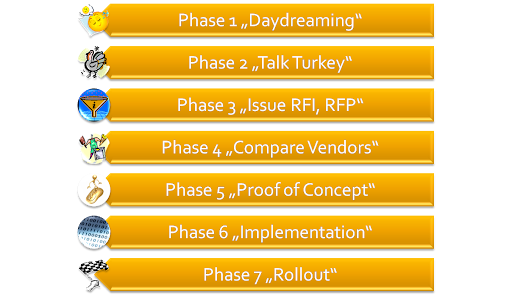
CRM 2.0 - Vendor selection process

Here are my thoughts about vendor selection process and implementation phases - any comments highly appreciated!


Phase 1 „Daydreaming“
  • Determine Business Needs
  • What are the challenges?
  • What was the initial reason to think about a new CRM strategy?
  • Get help from an external advisor if necessary.
  • Define the ideal CRM solution
  • Outline the Hi-Level requirements
  • See the company from a customers‘ perspective

Phase 2 „Talk Turkey“
  • Come back to reality – you can not archieve everything you wish (what about ROI?)
  • Sync with existing CRM strategy and business processes – approve a project
  • Priotize the wishlist – separate the crtitical points from the nice-to-haves
  • Discuss with customers, employees and advisors
  • Identify the technology to be used (i.e. SaaS)

Phase 3 „Issue RFI, RFP“
  • Create a list of required functionality
  • Send this list to anumber of vendors (4-8)
  • Find a rating scheme and qualify the returned answeres
  • Ask the vendors to create a proposed solution
  • Asses and compare the outlined solutions
  • Find the two (or three) best fitting vendors
  • Focus on the vendor rather than the product
  • Technology must fit the strategy!

Phase 4 „Compare Vendors“
  • Does the corparate culture fit?
  • Is the vendor financial stable and is the roadmap promising and complete?
  • Is the product future proof (technology, platform), can it grow with your company?
  • Pricing model and license cost
  • Cost of implementation and customization
  • Required Hardware

Phase 5 „Proof of Concept“
  • Find a business process that covers as much technical aspects as possibe but can be implemented within a three week timeframe
  • Ask vendors to implement this business process with their product on site
  • Have IT and business people supervise the customization and administration process – get their buy-in!
  • Finish with a workshop where the vendor presents the PoC and answers questions how it was done
  • Try to estimate the efforts for the full project

Phase 6 „Implementation“
  • Keep business involved - gather feedback from future users during the implementation phase
  • Create reusable application code
  • Keep future upgrades in mind
  • Involve customers as beta-testers
  • Favor a staged approach for a ‚big bang‘

Phase 7 „Rollout“
  • Let users decide, not the contract – usability is the most critical factor...
  • Design DOES matter!
  • Provide detailed information to users (employees and customers)
  • Training
  • Collect feedback and keep improving the functionality and business processes
Technorati Tags: , ,

Wednesday, July 2, 2008

CRM market still growing fast

AMR says the market for CRM software will grow with double digit rates.
This is pretty interesting given the fact that so many CRM projects still fail... Do companies realize that buying a CRM software is not sufficient to be successful?

What about the required changes to company strategy and employee behavior? According to AMR the Web 2.0 technology is mostly demanded in the SFA arena - but what about service and support? What about marketing and innovation?

Let's hope the software vendors get the basics right so that users of their platforms will finally be able to focus on the required strategic and behavioral changes towards CRM 2.0...

Technorati Tags: , ,

Thursday, May 1, 2008

Global Map for Social Networking


While signing up and testing out on different social networking platforms, I found that there is quite a difference in the user group and focus amongst them.

Although all the platforms are open to anyone in the world, most of the sites are only strong in certain regions, age groups or focus groups. How would a company choose where to engage within a CRM 2.0 strategy? What functionality is important for my customers and where are they probably sharing information (i.e. where can I reach them best)?

My idea was creating something like a global map for social networking platforms. Try to analyze which customer groups are signed up where and using which applications / functionality within the Web 2.0. Could this help corporates to define an effective CRM 2.0 strategy?