Showing posts with label marketing. Show all posts

Wednesday, October 22, 2008

Analogy to the TV revolution

Brian Halligan raised a good point - isn't the current (r)evolution of Customer Relationship Management (or Customer Relationship Model) very similar to the dramatic changes in Marketing with the introduction of the television 50 years ago?

The TV completely changed the way of marketing and 1089124_tvadvertising! Some companies were able to leverage the new tool and grow dramatically (Coca Cola, P&G, etc.) while others got stuck with their traditional way of marketing and did not grow or even went out of business.

Very similar to what the Web 2.0 does with CRM! Customers discovered how to avoid the traditional advertising - i.e. one way or push communication - overload and more and more using new ways to do their purchase decision. The social networking is playing an important role in this decision.

With a good CRM 2.0 strategy, companies can leverage this development and grow with it. Staying in the old fashioned structures might not be a good idea...

Friday, July 11, 2008

Next Best Action (NBA)


Just came across an article from Anette Mitchell (Architect of O2's NBA) and that reminds me of some requirements we came across when selling Amdocs CRM to Telco customers.

First we tried to implement a solution ourselves but soon recognized that it requires quite a bit of code and analytical CRM capabilities to suggest a product or action (could be a campaign or agent script) based on the customers history and customers that were in similar situations.

Some actions are pretty obvious and can be added 'manually' (like customers with a high probability of churn would get special churn scripts) - but for the complex decisions it requires a sophisticated analytical CRM technology that is able to find patterns in customers behavior and predict in real time what the contact might be looking for.
It must be real time as the current interaction with the customer might have massive influence on the NBA...

NBAs have the power to turn the call center from a cost center into a profit center. This has can massive influence on the customer experience but requires well trained staff and a technology generating high quality predictions. It is also crucial that such a system learns from customer decisions, e.g. do not offer same or similar products if already declined by a customer.

All this help to approach (inbound) customers only with offers that potentially generate value for them.

Technorati Tags: , , ,

Friday, July 4, 2008

Apple's customer experience


I just read an article about Apple that was confusing me because they for sure create a fantastic product experience, but they are probably the most un-collaborative (does this word exist?!) company in this arena. Apple is actually doing everything possible to not communicate with its customers. Their policy is to keep everything product related as secret as possible. Even different departments within the company do not know what the others are doing. That avoids that somebody gets the full picture of a new product and accompanied with strict prohibitions in the employees contracts about what they are allowed to talk and to whom, it allows Apple to gain a competitive advantage that is massive (expected three years for the iPhone). When products leave the labs at apple, they are extremely stable and have only few bugs (although they are found quickly and the example of the iPod battery shows that consumers are able to strike back...).
The buzz that is created by new apple products allows Steve Jobs to leave customers in the dark during the development process without harvesting the negative feedback that everybody would expect. While Google motto is "Don't be evil", it looks like Apple's is the opposite. The leadership methods of Apple are antipodal to the open and collaborative ones that are common in most of the Hi-Tec and Software companies these days.
Interesting enough - Apple is tremendously successful with this strategy, gaining more and more market space from companies like Microsoft that recently started to open up to it's customers. Is this just an exception or will this market - which seems to be a precursor for CRM 2.0 strategies - fall back into traditional ways of leadership and marketing?

Technorati Tags: , , ,
Undergoing MyBlogLog Verification

Monday, June 30, 2008

Presonalized Customer Experience - Something completely new?

When I was running today on my usual track, I was thinking about the new personalized customer experience and what is so new about it. I came to the conclusion that we already had this concept in the past. It is not so new!


In the corner shops in the past, there was a truly personalized experience. The lady behind the counter knew all her customers personally and treated everybody different. She recommended products which she believed were of good quality and delivered some value to the consumer.
By sharing the experience of other buyers of the same product she could back up her own preferences. Customers met in the store and shared their experiences themselves - positive and negative ones.
The conversations were not limited to products, though. The people that met in the store chatted about their daily life and shared stories about family and friends. Sometimes interested people would spend some more thoughts about peoples problems and create solutions (could be new products or services).


With the globalization in the last decades the consumer got bombarded with new and cheap products from all over the world.
Innovative products reached millions of customers without any thought about their special needs or potential problems with the usage in different environments. No need for extensive testing or customer feedback - competition was fought on price and features.
As customers started buying in big stores without the personal support from the personnel or via the internet without any personal contact, there was no way to make problems public about products or services. Other consumers would buy the products because of the nice and shiny advertisements and producers made good money with selling bad products.
Marketing was made by analysts that gathered data, ran some algorithms on them and created products they believed had a good potential on the market. Supported by massive TV, radio and print campaigns the products were introduced to the market and produced with an efficient and cost effective SCM. No one ever spend any thoughts on products and services could be personalized and how the customer could be involved in the creation and evolution of them. And actually for quite a while there was simply no way to do this!!

But now there is way (!) and companies need to re-think their process of inventing, marketing and producing goods. The empowered customer is now able to share her/his experience with millions of other users via the internet and there are ways to create a personalized experience even for thousands or hundreds of thousand users.

So isn't CRM 2.0 a kind of 'back to the roots' thing? Weren't we as customers missing the personal component of the selling-buying process in the past years - but still want to keep the advantages of a global marketplace where companies have to compete globally on price, features and quality?

Technorati Tags: , ,

Sunday, June 29, 2008

The Customer Experience

Some CRM vendors talk about Service and Support when they push the Customer Experience. But the full Experience of a product or brand is so much more than that (although service is a crucial part of it...)!

What is the Customer Experience and why is it so important?

Creating an Experience means that the consumer receives a product or service that emotionally touches her/him and leaves an impression that is positive in all areas.


The Web 2.0 technologies allow empowered customers to share their experience with thousands of other users or potential users. If the experience is negative it will seriously harm a brand - if it is positive the customer becomes an advocate and kicks of the viral marketing machine (don't like that term).

A CRM 2.0 strategy must acknowledge the power of customers and actively create an Experience that is unique and all positive. This could be achieved by engaging the customer in a real dialogue and listen carefully to what e says. Innovation has to be a central part in such a strategy as well. Innovation from both sides, internally and externally.

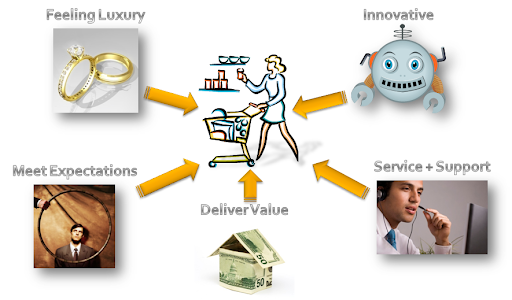
The consumer will only become an advocate for a brand or product if if it delivers a great value (which is not related to the price!). In general the consumer is looking for products and services that leave them with a good feeling which might be created by innovation, the price, the uniqueness or the reputation.

Technorati Tags: ,

Friday, May 16, 2008

Treat women different?

Jackie Huba is raising an interesting point when she explains the differences of men and women when it comes to the word of mouth.

Although I agree that there are differences, I would say (as an affected person :) that most of the arguments she raises also apply to men. I would tend to say that it is a matter of the product if you personalize your CRM towards women or men. And this could lead to differences that vary from the color scheme of the website to the wording or functionality.

Interesting point, though. Need to keep this in mind - maybe there is a different CRM 2.0 strategy if the audience is mostly male or female?

Technorati Tags:

Sunday, April 20, 2008

Day 7 - Two Way CRM

Currently most of the CRM activities are initiated and driven by business rather than the customer. With CRM 2.0, this can change as the customer will play a much more active role in this relationship.
By providing data and deciding whom to provide the data, the customer actively steers the purchase decision and will speak to companies on the same level. Ideally, the relationship will be much deeper and the company is rewarded by true loyalty from the customer.
While most of the current marketing activities are based on analyst recommendations which derive their data from anonymous surveys the might - or might not - represent the consumers' demand, CRM 2.0 can help to let the customer take part in the creation and development of new products.
This will not only lead to new ideas and inventions, but also save cost and deepen customer retention.