Showing posts with label experience. Show all posts

Friday, September 2, 2011

Interactive Chat as a support (and sales) channel

image

I just read an internal memo about the huge success of our (SAS) “proactive chat” feature and was thinking about my masters' thesis, where I stated that the standard triple of telephone, mail and email might not be sufficient anymore and additional channels help to establish a better relationship with customers.

I cannot disclose the numbers here, but in terms of revenue generation, I was actually stunned how the chat feature helps to make money and generate leads. Now given this success, one can only anticipate how this helps improving customer relationships through an outstanding support experience.

While SAS putting a lot of effort into this – like a real-time decision when and how to present the chat feature – and has a large Inside Sales team to handle these incoming chat requests, it is also possible for very small companies to extend their list of channels by a chat.

I recently bought a new TV and while looking for the best price I was stumbling across a very small shop (probably a one-man show) that had a very good price and was pretty close, so I could go there and get the TV the same day while saving the shipping cost.
I had some questions and wanted to get a better feeling (since the price was really low), but writing an email was taking too long and I felt calling him might be a bad idea because it might interrupt too much and I would need several calls to answer questions that were coming up while I was still reading about the TV in the internet and comparing other prices.

The intermediate between a telephone call and an email was a chat. There was no fancy web-chat feature on the store’s website, but he had simply put a Skype-Button on it that was showing if he was online and available..
image

Cost free and still very convenient!

He could answer my questions, make me feel good about his business and got the deal… simple as that.

Bottom line is that there are many ways to use technology to help build a better / trusted relationship with your customers and improving the customer experience.

Chat is one of the channels that is increasingly getting popular as it fills the gap between phone calls and emails. Chat messages are more interactive and faster than email while still not as interruptive as a phone call.

Have you had a similar experience? Is your company also supporting chat as a medium the get in contact with customers?

Technorati Tags: ,,

Friday, December 26, 2008

CRM 2.0 tipping point?

questionmark What will be the tipping point for CRM 2.0? What (and when) will be the single event to make it mandatory for every company to succeed?

Will it reach the critical mass at all!? Is this just another hype and one more buzzword that will be forgotten in two years?

There are examples like Apple that show it is possible to operate a successful company without actively including customers in the process of creating and evolving products and services (although they do a very good job in listening to their customers...)

Maybe there will be two kinds of CRM strategies in the future - one that gets into a true two-way discussion with the customer and builds on co-creation and co-operation; and another one that keeps focus on operational efficiency or competitive advantage through unique (kept secret as long as possible) features and functions?

I believe it is possible to create an outstanding customer experience without any CRM 2.0 strategy. It might depend on the product or the corporate culture if it makes sense to deeply involve customers in the processes or not.

Taly Weiss collected some predictions form 'Social Media influencers' on what they think will change in 2009:

A Merry Christmas to all of you out there...

Monday, October 20, 2008

Social CRM is not a product you can buy!

When I am reading through Oracle's Vision of Social CRM (http://www.oracle.com/applications/socialcrm/index.html) I keep thinking that this is really missing the "social" component at all.

What defines a CRM to be "social" ?
How can a product help you achieve this ?
What is the outcome of social CRM ?

Adding some Web 2.0 collaboration tools doesn't help without a properly defined and executed (yes, I came to the conclusion that excution is AS important than strategy :) CRM 2.0 strategy.

It is all about how we leverage the existing tools to create a unique customer experience that differentiates a company from competition. There is no CRM 2.0 installer! There is no way around activating the brain and spending some thoughts of how that really works...

Tuesday, July 8, 2008

Co-Creation - one step beyond customer feature proposals...

I was thinking before how you could create a community like the open source one or the flock of free plug-in and gadget developers that actively create content and share it (being proud of their creations) while still having a business model and earn money from it.

Obviously it is hard to find an example in the software arena as only few people are willing to spend money on Software in times of Linux and OpenOffice. But Paul has found a very good example of a clothing store called Fashionology LA.

Read his blog post about what the store is doing to create a unique customer experience that customers are willing to pay a premium for.

I wonder if the Apple Store (iPhone v2) will be an example of a successful implementation in the IT world. The fact that content creators are able to offer their programs for free makes me doubtful... Although there will be a good solution for the micro-payment via the mobile service-provider.

Technorati Tags: , , ,

Friday, July 4, 2008

Apple's customer experience


I just read an article about Apple that was confusing me because they for sure create a fantastic product experience, but they are probably the most un-collaborative (does this word exist?!) company in this arena. Apple is actually doing everything possible to not communicate with its customers. Their policy is to keep everything product related as secret as possible. Even different departments within the company do not know what the others are doing. That avoids that somebody gets the full picture of a new product and accompanied with strict prohibitions in the employees contracts about what they are allowed to talk and to whom, it allows Apple to gain a competitive advantage that is massive (expected three years for the iPhone). When products leave the labs at apple, they are extremely stable and have only few bugs (although they are found quickly and the example of the iPod battery shows that consumers are able to strike back...).
The buzz that is created by new apple products allows Steve Jobs to leave customers in the dark during the development process without harvesting the negative feedback that everybody would expect. While Google motto is "Don't be evil", it looks like Apple's is the opposite. The leadership methods of Apple are antipodal to the open and collaborative ones that are common in most of the Hi-Tec and Software companies these days.
Interesting enough - Apple is tremendously successful with this strategy, gaining more and more market space from companies like Microsoft that recently started to open up to it's customers. Is this just an exception or will this market - which seems to be a precursor for CRM 2.0 strategies - fall back into traditional ways of leadership and marketing?

Technorati Tags: , , ,
Undergoing MyBlogLog Verification

Monday, June 30, 2008

Presonalized Customer Experience - Something completely new?

When I was running today on my usual track, I was thinking about the new personalized customer experience and what is so new about it. I came to the conclusion that we already had this concept in the past. It is not so new!


In the corner shops in the past, there was a truly personalized experience. The lady behind the counter knew all her customers personally and treated everybody different. She recommended products which she believed were of good quality and delivered some value to the consumer.
By sharing the experience of other buyers of the same product she could back up her own preferences. Customers met in the store and shared their experiences themselves - positive and negative ones.
The conversations were not limited to products, though. The people that met in the store chatted about their daily life and shared stories about family and friends. Sometimes interested people would spend some more thoughts about peoples problems and create solutions (could be new products or services).


With the globalization in the last decades the consumer got bombarded with new and cheap products from all over the world.
Innovative products reached millions of customers without any thought about their special needs or potential problems with the usage in different environments. No need for extensive testing or customer feedback - competition was fought on price and features.
As customers started buying in big stores without the personal support from the personnel or via the internet without any personal contact, there was no way to make problems public about products or services. Other consumers would buy the products because of the nice and shiny advertisements and producers made good money with selling bad products.
Marketing was made by analysts that gathered data, ran some algorithms on them and created products they believed had a good potential on the market. Supported by massive TV, radio and print campaigns the products were introduced to the market and produced with an efficient and cost effective SCM. No one ever spend any thoughts on products and services could be personalized and how the customer could be involved in the creation and evolution of them. And actually for quite a while there was simply no way to do this!!

But now there is way (!) and companies need to re-think their process of inventing, marketing and producing goods. The empowered customer is now able to share her/his experience with millions of other users via the internet and there are ways to create a personalized experience even for thousands or hundreds of thousand users.

So isn't CRM 2.0 a kind of 'back to the roots' thing? Weren't we as customers missing the personal component of the selling-buying process in the past years - but still want to keep the advantages of a global marketplace where companies have to compete globally on price, features and quality?

Technorati Tags: , ,

Sunday, June 29, 2008

The Customer Experience

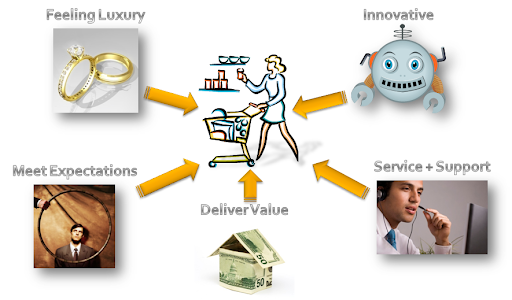
Some CRM vendors talk about Service and Support when they push the Customer Experience. But the full Experience of a product or brand is so much more than that (although service is a crucial part of it...)!

What is the Customer Experience and why is it so important?

Creating an Experience means that the consumer receives a product or service that emotionally touches her/him and leaves an impression that is positive in all areas.


The Web 2.0 technologies allow empowered customers to share their experience with thousands of other users or potential users. If the experience is negative it will seriously harm a brand - if it is positive the customer becomes an advocate and kicks of the viral marketing machine (don't like that term).

A CRM 2.0 strategy must acknowledge the power of customers and actively create an Experience that is unique and all positive. This could be achieved by engaging the customer in a real dialogue and listen carefully to what e says. Innovation has to be a central part in such a strategy as well. Innovation from both sides, internally and externally.

The consumer will only become an advocate for a brand or product if if it delivers a great value (which is not related to the price!). In general the consumer is looking for products and services that leave them with a good feeling which might be created by innovation, the price, the uniqueness or the reputation.

Technorati Tags: ,

Friday, May 16, 2008

Cross-Channel Integration

Image:Bonjour Browser.pngIf you - as a company - want to create a truly positive customer experience, there will be no way around the integration of all the different contact channels.
This was already a hot topic in the CRM 1.0 days (and still is) and led to terms like the "360 degree view on a customer". But having all the information available at the agents fingertips is not everything needed to create an experience.
In addition to the collection of data and making it available in the front office, the analytical side of CRM needs to take all this data into consideration as well when it comes to real time offering suggestions or campaign management. Additionally the customer wants to get the same experience independent on the channel he is using. There should be no difference between an email, a letter or a phone call to a business.
I am one of the typical "1st try an email..." type of guys. And guess what, I am getting really upset when it takes 3 weeks to answer my email but the agent on the phone can resolve the issue within 10 secs. Does it also take three weeks to answer a mail - or are they considered more important?

It looks like the processes in a CRM 2.0 environment need to change dramatically from the current ones, that seem to have strong preferences on certain channels (while ignoring some others completely).

The following questions need to be considered in a CRM 2.0 implementation:
  • What channels do I need to serve?
  • What are the costs involved (opening new channels will disburden others)?
  • How can I make sure the experience is the same across channels?
  • What channels do my customers prefer (each customer individual)?

Technorati Tags: , ,

Customer Feedback

Ben McConnell did a nice post in his blog about customer feedback that doesn't really fulfill its purpose.

Besides filtering the customer feedback and suggestions, asking the right questions and leaving the customer the freedom of choice in his answers (and the channel), is crucial.

How can this be incorporated in a proper CRM 2.0 strategy? I will add a reminder in the strategy discussion...


Technorati Tags: ,

Tuesday, April 15, 2008

Day 2 - Customer Experience

While reading through many articles about CRM 2.0 or the development of CRM in general, I am coming along the "Experience" notion more and more often.
It looks like many companies that sell CRM software or services have finally understood that CRM is more than a software for contact management and that outstanding customer service can be a differentiator for companies when their products become a commodity.
This awareness changes the way CRM solutions and services are marketed and also their functionality. Many companies include Web 2.0 elements into their products to follow this trend and fulfill customer requirements.
So it looks like there is some demand on the market for CRM 2.0 and the software vendors are picking up that trend already. But still I have the feeling that there is no common definition of what CRM 2.0 really is and how it can add business value to customers (and the customer's customers).